Sauk County Health Department came to us with an AI question. Before touching anything, I ran 50 interviews across local health departments to see what was actually happening on the ground. What I found wasn't a tools problem.
Staff were copying protected health information into free consumer chatbots. Directors trusted AI outputs for grant writing without understanding the limitations. Legal teams didn't know the exposure. The technology wasn't the problem. The policy vacuum was.
Once the policy framework was in place, we built the tool: a HIPAA-compliant, RAG-based food code assistant for Sauk County's environmental health inspectors. Ask a question in plain language, get a citation from the actual food code in seconds, not the 30 minutes of PDF hunting it used to take.
I hand-coded the first prototype in HTML, not to ship it but to get something real in front of users fast. Then I iterated side-by-side with inspectors. I tightened prompt phrasing, matched the tone to departmental style, and found out inspectors wanted it for drafting follow-up emails too.
I tested 5+ LLMs against real public health tasks (grant writing, policy summarization, data interpretation, response drafting) and scored outputs blind. AWS Bedrock won for one non-negotiable reason: HIPAA compliance. It keeps data within your AWS org and makes it possible to sign a BAA. The test results didn't matter if the data couldn't stay inside the customer's environment.

The Food Code Assistant, deployed for Sauk County Health Department
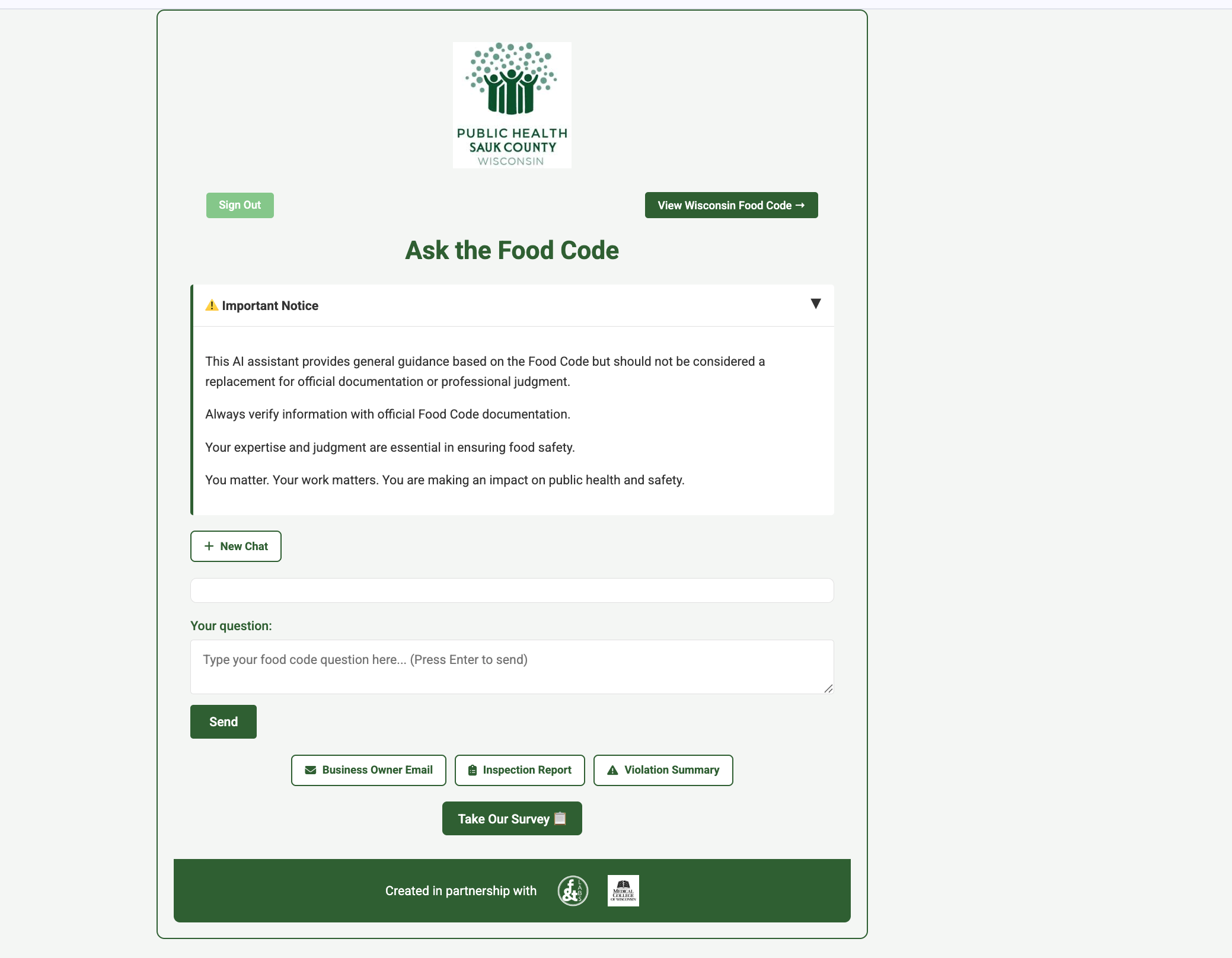
The chat interface: inspectors ask questions, get answers grounded in the actual food code
Sauk County Health Department
Routine tasks that took 30 minutes now take 5. 83% of inspectors reported reduced workload. 67% rated the tool as very or somewhat effective in early testing.
That's not "AI made things faster." It's inspectors getting hours back per week to do the work that actually requires a human. And it only happened because we solved the policy problem first.
What we built for Sauk County became the foundation for PH360, F&T Labs' platform for AI in local public health. One client, one real problem, solved right, then productized.
A strategic plan became a proving ground, and a shared stage.
Sauk County didn’t start as an AI engagement. It started as a strategic plan: I led their full planning process, every focus group, the retreat, the plan itself. Doing that work well earned the next conversation. Process mapping followed, then a data storytelling workshop, then their first AI tool: the food code assistant on this page.
Small engagements become big ones when you keep solving the real problem in front of you. By 2024, we were sharing a plenary stage with the department whose strategic plan was the whole original scope. That trust arc, not any single deliverable, is what turned one county’s question into PH360.